

Managing the lifecycle of Cisco networking hardware and software is critical for maintaining network security, performance, and compliance. Cisco defines formal End-of-Life (EoL) and End-of-Sale (EoS) policies to guide organizations in planning device replacement and upgrades. Planning for EoL/EoS transitions ensures your network remains secure, supported, and optimized without unexpected downtime or costs.
To simplify lifecycle management, IT teams can leverage the free multi-brand EOL/EOSL Checker Tool from EOL Checker & Lookup Tool | End of Life & EOSL Database, which provides verified, up-to-date lifecycle information across Cisco, HPE, Juniper, Dell, Aruba, Arista, and other vendors.

Part 1: Defining Cisco EoL and EoS Milestones
Cisco products eventually reach the end of their lifecycle due to market demand, technological innovation, or product maturity. EoL applies to all hardware, software, cloud services, and service offers with a unique product ID (PID). Meraki products follow a dedicated Meraki EoL policy.
The EoL process consists of technical and business milestones, after which a product is considered obsolete — it is no longer sold, maintained, or supported.
Key EoL Milestones:
- EOL Notification Date: Date when EoS and EoL milestones are publicly announced.
- End of Sale Date (EoS): Date after which the product is no longer offered for sale (typically notified ~6 months in advance).
- Last Date of Support (LDOS): Final date to receive support under active contracts (varies by product).
Part 2: Support Timelines and Contract Management
Cisco offers post-EoS support to customers with active service contracts. Key provisions include:
- Hardware Replacement (RMA): 5 years – Replacement parts per Cisco RMA process.
- TAC Support (Hardware): 5 years – Technical Assistance Center support for hardware.
- Routine Failure Analysis: 1 year – Routine hardware failure analysis.
- Bug Fixes / Maintenance Releases: 1 year – OS/software bug fixes and patches reported to TAC.
- Extended OS Bug Fixes: +2 years – Additional fixes/workarounds for OS software.
- Extended Application Bug Fixes: +1 year – Additional fixes for application software.
- Last Customer Ship Date: 3 months – Final hardware shipment date.
Note: Customers may add new support contracts for up to 1 year from EoS, provided the end date does not exceed LDOS.
Part 3: Identifying EoL Hardware and Software
Cisco maintains public EoL/EoS product listings. Organizations should monitor these to plan replacements and budget accordingly.
Common EoS Products:
- Cisco 4000 Series Integrated Services Routers (4451-X, 4351, 4221) – Routers
- Cisco Catalyst 3850 & 2960-X Series Switches – Switches
- Cisco Unified Communications Manager 12.5, 11.5 – Software
- Cisco Aironet 3800 Series APs – Wireless
- Cisco Prime Infrastructure 3.9 / 3.10 – Management Software
- Cisco Nexus 7000 Series – Data Center Switches
- Cisco ASA 5500-X Series – Security Appliances
Part 4: The Upgrade Path Strategy
Upgrading EoL hardware involves moving to newer platforms with modern features:
- Cloud-enabled management and monitoring
- AI-driven analytics
- Advanced security integrations
- Performance optimization
Case Example: Embedded Services Routers (ESR)
Customers using ruggedized, mission-critical ESR hardware require replacements that maintain high reliability and support current OS functionality.
For example, Cisco 5915 and 5940 ESRs have reached EoL. Replacement devices, like XChange6300 ESR, offer:
- Security: Hardware encryption, IPS, Zone-based Firewall
- Routing: RIP, OSPF, EIGRP, BGP
- Mobile Networking: Radio Aware Routing, Mobile IP
Organizations can use the EOL Checker & Lookup Tool | End of Life & EOSL Database to quickly identify if existing Cisco or other vendor devices are approaching end-of-sale or end-of-life, plan replacements, and optimize procurement costs.
Part 5: Resources and Next Steps
- Regularly check Cisco’s official EoL/EoS listings.
- Subscribe to notifications for EoS announcements and security advisories.
- Consider Cisco Refresh certified remanufactured equipment for cost-effective replacements.
- Engage Cisco partners or experts for guidance on device transitions.
- Use the EOL Checker & Lookup Tool | End of Life & EOSL Database to map your current inventory against EoL/EoS timelines.
Part 6: Using the Router-switch EOL/EOSL Checker Tool
Managing EOL across multiple vendors can be complex, especially with diverse hardware and software. Router-switch provides a free, multi-brand EOL/EOSL Checker Tool that centralizes verified lifecycle data.
Key Features of the Tool:
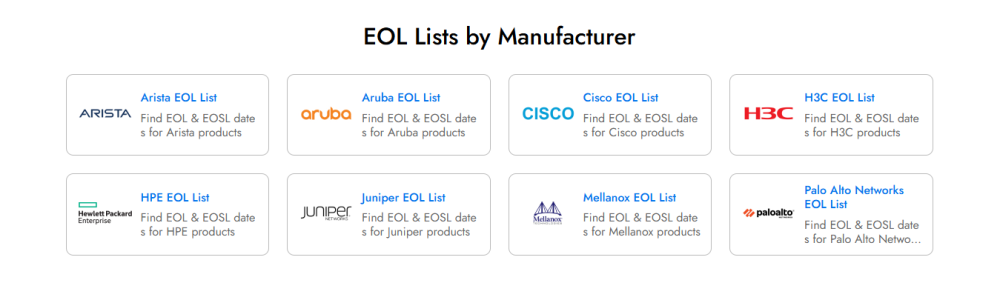
- Multi-Brand Coverage: Cisco, HPE, Juniper, Dell, Aruba, Arista, and more; hardware and software products from switches to servers, storage, and network accessories.
- Official and Updated Data: Verified against vendor announcements; updated monthly for accurate EoS and EoL dates.
- Comprehensive Product Categories: Switches & routers, firewalls & security appliances, wireless access points, unified communications, servers & storage, optical access networks, video surveillance, and software licenses.
- User-Friendly Interface: Search by product name, part number, or model; quickly locate EOL announcements, End-of-Sale dates, and LDOS; export results for internal tracking, budgeting, and upgrade planning.
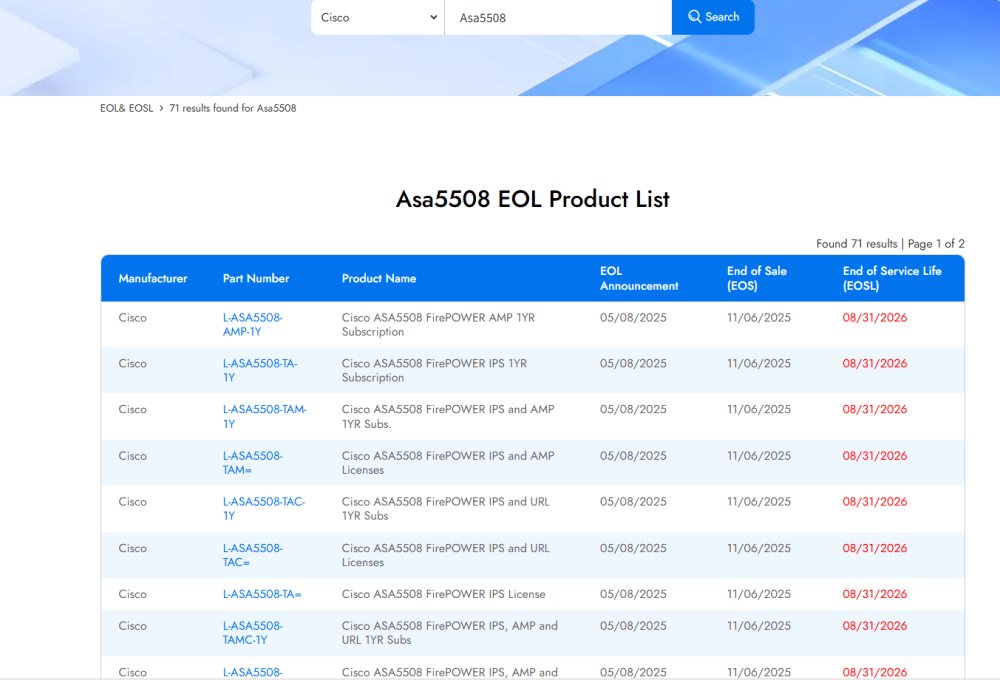
Example: Cisco 5508 FTDs
Manufacturer | Part Number | Product Name | EOL Announcement | End of Sale (EoS) | End of Service Life (EOSL) |
| Cisco | L-ASA5508-AMP-1Y | Cisco ASA5508 FirePOWER AMP 1YR Subscription | 05/08/2025 | 11/06/2025 | 08/31/2026 |
| Cisco | L-ASA5508-TA-1Y | Cisco ASA5508 FirePOWER IPS 1YR Subscription | 05/08/2025 | 11/06/2025 | 08/31/2026 |
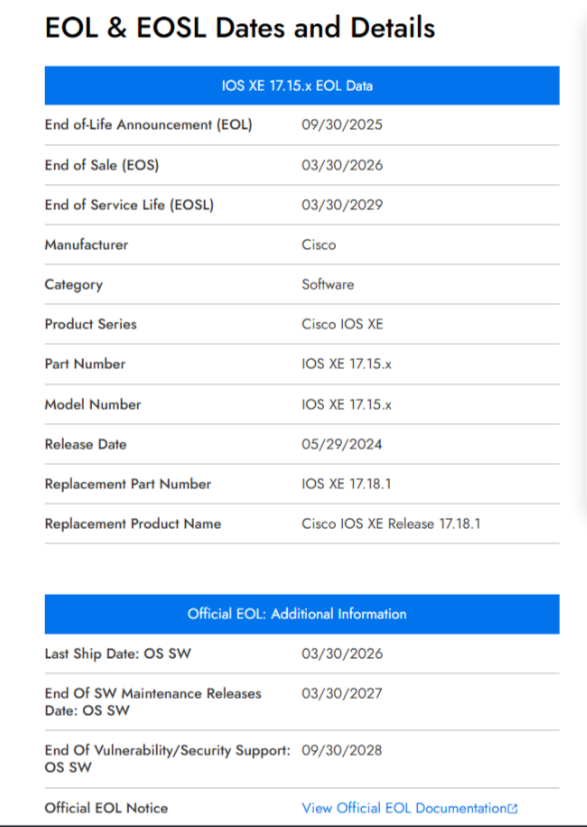
IT teams can plan support renewals, replacements, and OS upgrades proactively without waiting for scattered notifications.
Integrating the Tool Into Your Workflow:
- Quarterly Review: Monitor lifecycle status and prepare replacement schedules.
- Budget Alignment: Export reports for cost planning and license renewals.
- Risk Mitigation: Identify unsupported devices early to avoid operational or security issues.
Start your free multi-brand EOL/EOSL check now at EOL Checker & Lookup Tool | End of Life & EOSL Database and streamline your lifecycle management process.
Part 7: Conclusion: Turning EOL Awareness into a Strategic Advantage
Proactive lifecycle management reduces security risks, ensures software compliance, and prevents costly disruptions. By integrating EOL monitoring, multi-vendor insights, and upgrade planning, IT teams can confidently plan hardware refreshes, software migrations, and budget cycles.
With tools like the Router-switch free multi-brand EOL/EOSL Checker, enterprises gain verified lifecycle data at their fingertips—making lifecycle management a strategic advantage rather than a reactive burden.
FAQ
Q1: What does Cisco EoL mean?
End-of-Life (EoL) marks the point where Cisco no longer sells, improves, or supports a product. Devices may still function but are not officially supported.
Q2: What is the difference between EoS and EoL?
End-of-Sale (EoS) means the product is no longer available for purchase. EoL refers to the final phase of product support and lifecycle management.
Q3: How can I find which devices are approaching EoL?
Use Cisco’s official EoL/EoS listings or the EOL Checker & Lookup Tool | End of Life & EOSL Database to check your inventory.
Q4: What happens if EoL devices fail?
After support expires, TAC assistance, firmware updates, and replacements are unavailable. Organizations must plan upgrades proactively to avoid downtime or security risks.
Q5: How do I plan an EoL upgrade?
Identify impacted devices, compare replacement options, check budgets, and schedule replacements to maintain operational continuity. Tools like the EOL Checker & Lookup Tool | End of Life & EOSL Database simplify planning.

Expertise Builds Trust
20+ Years • 200+ Countries • 21500+ Customers/Projects
CCIE · JNCIE · NSE7 · ACDX · HPE Master ASE · Dell Server/AI Expert

